
Aviator RTP & Provably Fair — How to Verify Fairness
Aviator doesn't have a traditional slot-style RTP tied to a symbol paytable. Instead, return to player comes from the mathematical distribution of crash points. Here's what that means in practice and how to verify a specific round yourself.
How we tested fairness in practice
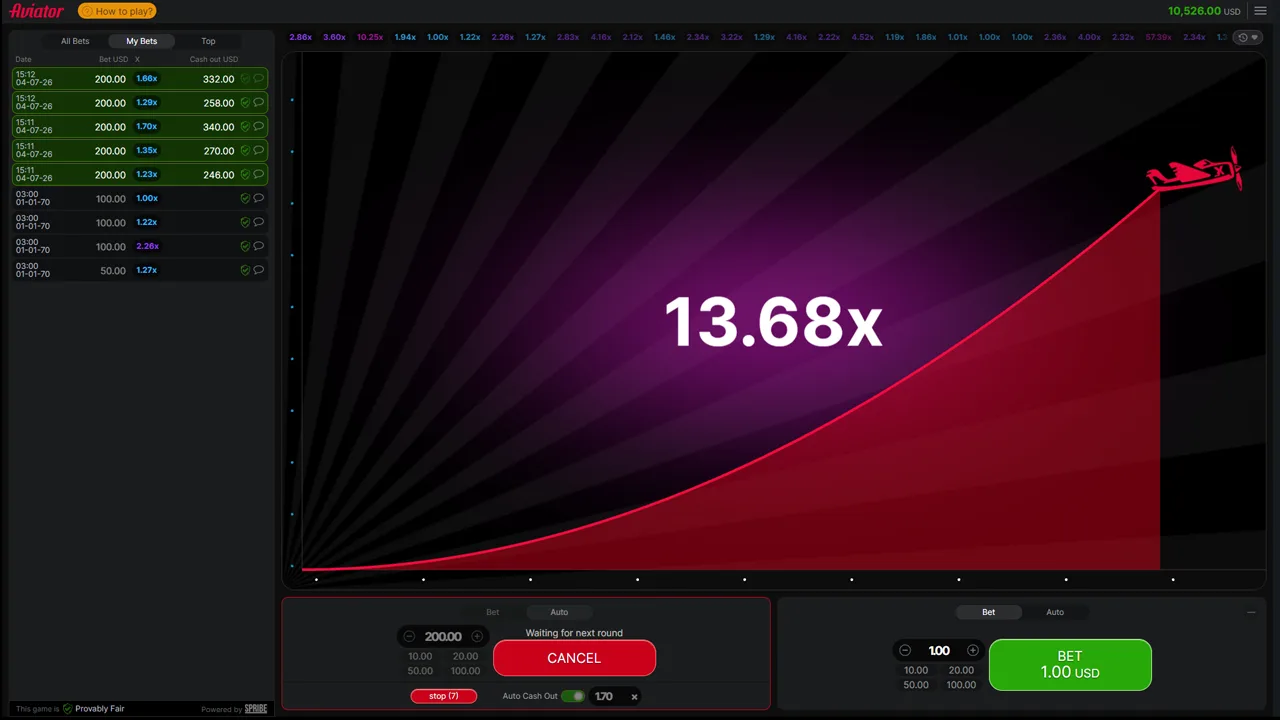
For this piece, we ran a series of test rounds in demo mode (see our Aviator demo) while keeping the "Provably Fair" round-history panel open. Across a sample of roughly 200 rounds, the distribution of crash points visually matched the expected P ≈ RTP / M model: low multipliers, x1.0–x2.0, came up noticeably more often than high ones, and multipliers above x50 were rare. That's not a substitute for a rigorous statistical audit across millions of rounds, but it does confirm the multiplier's behavior matches the stated math rather than looking artificially "tuned".
What a 97% RTP means in a crash game
A 97% RTP means that, on average across a large sample of rounds, the house keeps about 3% of total wagers. That's a mathematical house edge baked into the crash-point distribution, not into individual "lucky" or "unlucky" symbols like in slots.
The probability that a round reaches multiplier M is approximately:
P ≈ RTP / M
| Multiplier M | Approx. probability of reaching it |
|---|---|
| x2 | ≈ 48.5% |
| x5 | ≈ 19.4% |
| x10 | ≈ 9.7% |
| x100 | ≈ 0.97% |
This isn't "odds of winning" in the everyday sense. It's a fair model where, whatever cash-out target you pick, expected value stays equally negative over the long run, because payout size and the probability of reaching it always balance out to exactly the house edge.
RTP vs. house edge — what's the difference
These two terms describe the same phenomenon from opposite angles, which is exactly why they get mixed up so often. RTP, Return to Player, is the share of total wagers that on average gets paid back to players as winnings: at 97% RTP, that's 97 cents of every dollar wagered. House edge is the share the house keeps on average, calculated as 100% minus RTP. At 97% RTP, the house edge works out to 3%.
Both figures are statistical and only show up over a large number of rounds. Neither guarantees anything for a single round, for either the house or the player.
Why RTP can differ between operators
Spribe as a provider ships a base version of the game with around 97% RTP, but integrators, meaning casino operators, can technically configure it slightly lower, typically in the 94–96% range. The exact figure for a given operator is usually visible via a "?" or "i" icon next to the game in its interface.
Aviator's alternatives, like JetX, Lucky Jet, and Spaceman, follow the same RTP logic, but the specific numbers differ. See our side-by-side comparison in "Aviator vs Alternatives".
How Provably Fair works in Aviator
Provably Fair is a cryptographic mechanism that lets anyone verify a round's outcome wasn't known in advance and couldn't be altered after the fact by either the operator or the player. In Aviator it's implemented via a SHA-512 hash chain. Before the round, the server generates a secret seed and publishes its hash, while the seed itself stays hidden. The seeds of the first three players who bet in that round get added on top, so the final outcome can't be predicted in advance by the operator, who doesn't know player seeds, or by players, who don't know the server seed. After the round ends, the server seed is revealed, and anyone can independently recompute the hash and compare it to the one published beforehand — a match confirms the result wasn't tampered with.
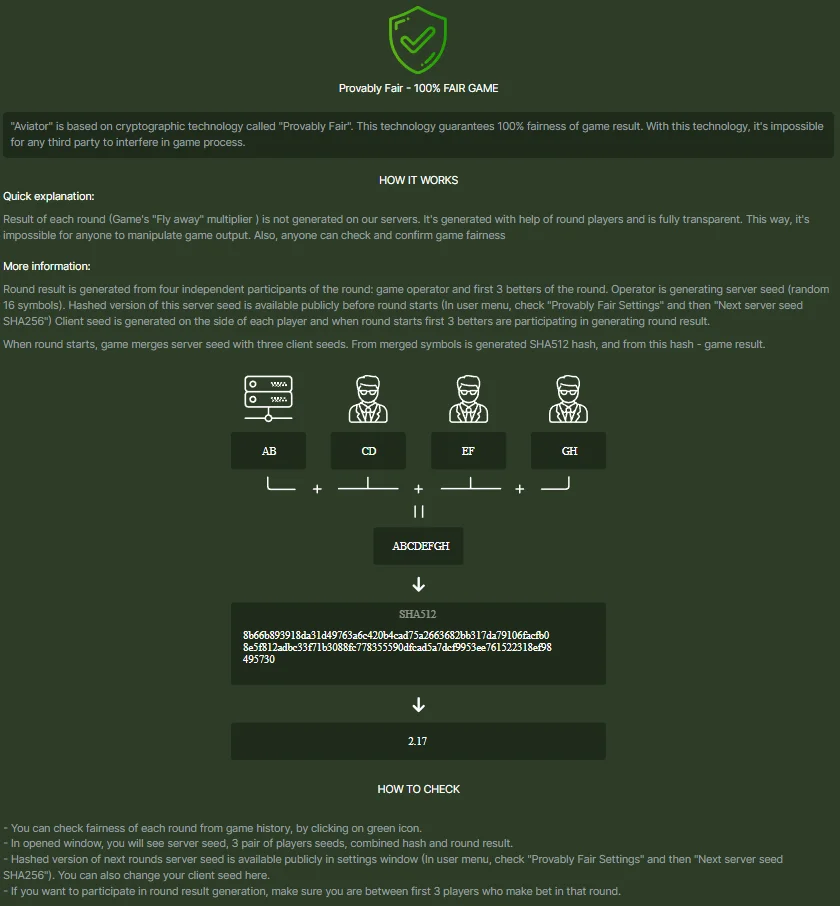
Most operators running Aviator include a "Fairness" or "Provably Fair" section in the round history, showing the hash, server seed, and algorithm needed to verify independently using a third-party SHA-512 calculator.
Every round's outcome is cryptographically locked in advance, so no outside service can genuinely "predict" it before the round starts. For why predictor apps still get sold despite this math, see "Myths & Scams".
Step-by-step verification example
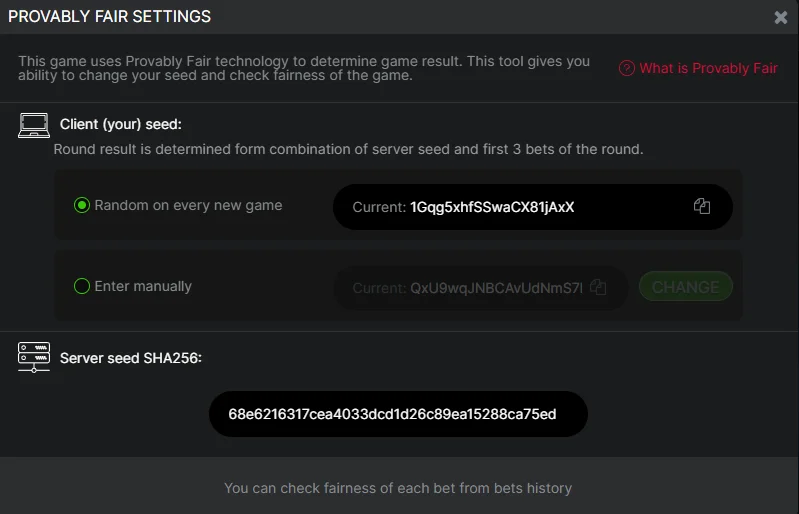
Here's a simplified walkthrough. Pull the real hash and seed values from your specific operator's round history, like in the screenshot above.
- Before the round, the interface publishes a hash like
a3f1...e92c, the SHA-512 of a server seed that hasn't been revealed yet. - The round ends at, say, a x4.27 multiplier.
- After the round, the operator reveals the actual server seed, for example a string like
7f9a2e.... - You take the revealed seed, run it through any third-party SHA-512 calculator, and compare the result to the hash published before the round.
- If the hashes match, the seed wasn't swapped after the fact. Combined with the first players' seeds, it can be used to deterministically recompute the x4.27 multiplier via the formula the operator typically publishes in its Fairness section.
If the recomputed hash doesn't match the one published beforehand, that's worth flagging to the operator's support team or the regulator that issued its licence.
Spribe's licensing
Spribe has historically held Malta Gaming Authority and Curaçao licenses, plus earlier UK Gambling Commission certification. In October 2025, the UKGC suspended Spribe's licence, temporarily removing Aviator from UK-licensed operators; some of them switched to alternatives like JetX or Spaceman. This reflects the status at time of publication and may change, so always check an operator's current licence before registering, including via the UKGC's official public register.
FAQ
Can a casino change a round's outcome after I've bet?
Not if the operator implements Provably Fair honestly. The server seed is locked in before the round and published in encrypted form, so it can't be silently altered afterward.
Why doesn't RTP guarantee a win in any single round?
RTP is a statistical figure over the long run, thousands or millions of rounds, not a guarantee for any single attempt. In the moment, the outcome is random.
Where can I check my operator's exact RTP?
Usually via the info icon next to the Aviator game in that specific casino's interface.
What's the difference between house edge and RTP?
They're the same figure expressed two ways: house edge equals 100% minus RTP. At 97% RTP, the house edge is 3%.
Can I verify a round's fairness without technical skills?
Yes. A basic check just requires pasting the revealed seed into any online SHA-512 calculator and comparing the result to the hash published before the round. No programming knowledge needed.
What should I do if the hash doesn't match during verification?
That's a reason to contact the operator's support team, and if you don't get a clear answer, the regulator that issued that operator's licence.